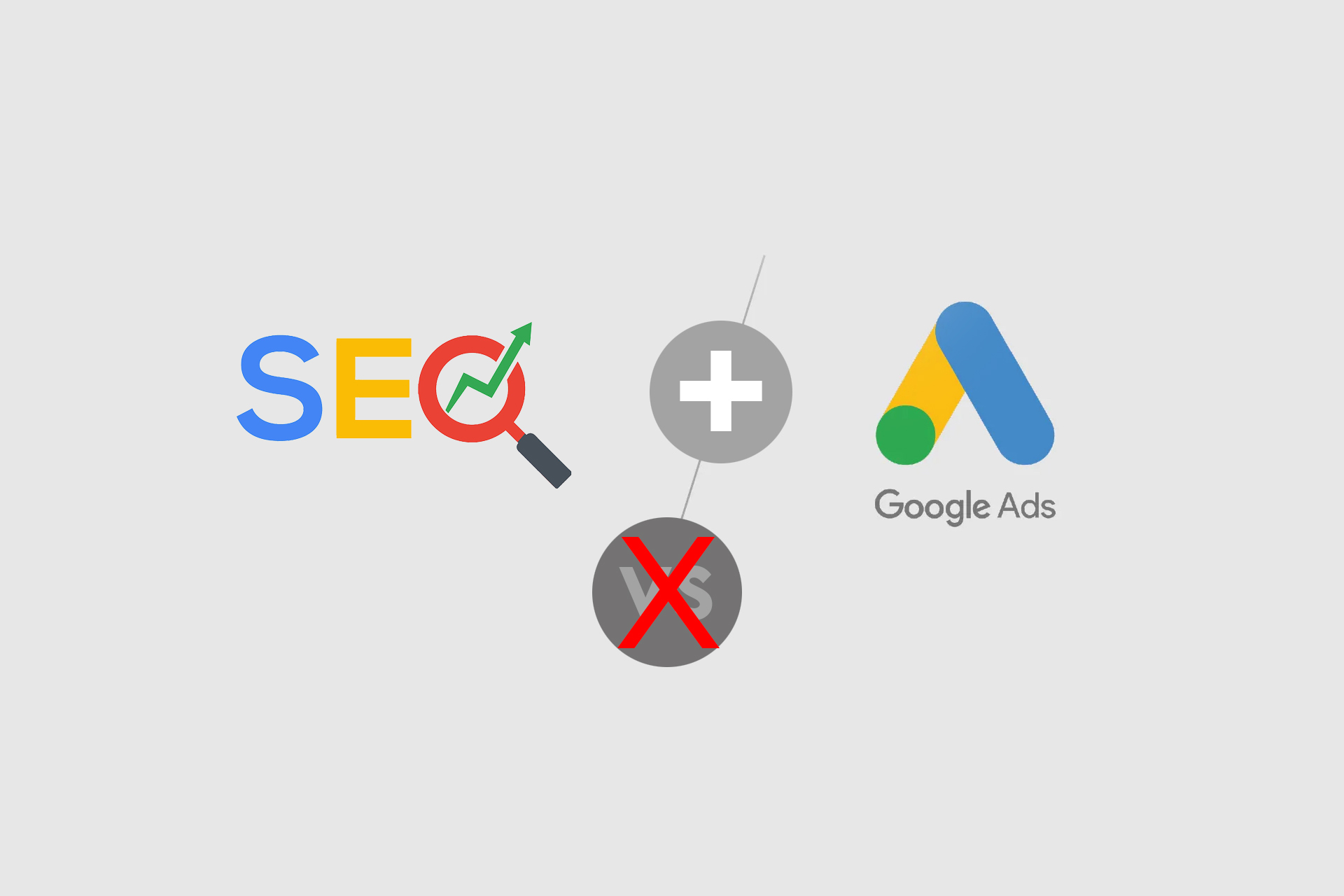
SEO and Google Ads Strategy – Modern brands are no longer choosing between SEO or Google Ads — they’re leveraging both to dominate the search journey from every angle. This article breaks down why the old “SEO vs Ads” mindset no longer works, how user behaviour has shifted, and why integrated search is now the core of sustainable growth. You’ll learn how organic and paid search fuel each other, how to build a full-funnel strategy, and how businesses in Bali can turn search into a long-term revenue engine.
The Big Misconception
For years, one question has quietly shaped boardroom conversations, marketing budgets, and digital transformation plans: “Should we choose SEO or Google Ads?”
It’s a perfectly reasonable question at first glance. After all, both channels require investment, both promise online visibility, and both play very different roles in driving growth. So it’s no surprise that many leaders default to treating them as competing options—an either/or choice where only one can win the budget for the quarter.
But here’s the problem: that mindset is now completely outdated.
Modern search behaviour has evolved far beyond the old “SEO vs Google Ads” debate. Customers don’t move through a simple, linear funnel anymore. They don’t rely solely on organic listings, nor do they trust ads alone. They move fluidly across devices, platforms, and touchpoints, consuming a mix of search results—organic, paid, local listings, maps, snippets, videos—often within the same decision cycle.
Which means the real strategic question today isn’t: “Which one should we choose?” but rather: “How do we use SEO and Google Ads together to maximise our return?”
And yet, despite a decade of clear data showing the power of combined search strategies, decision-makers across industries—hotels, tours, real estate, professional services, ecommerce—still get stuck. Not because they lack intelligence or vision, but because the digital landscape is complex, noisy, and often full of conflicting advice.
Some agencies push SEO as the “only sustainable solution.”
Some push Google Ads as the “fastest way to win.”
Some pitch one simply because they don’t have the capability to manage both.
And others still cling to the old belief that you “run Google Ads only until your SEO improves,” then switch off the budget.
In reality, this thinking limits your visibility, slows growth, and leaves your brand vulnerable to competitors who appear in every corner of the search results while you show up in only one.
This article is designed to cut through the noise and give you what most teams don’t: a clear, executive-friendly framework for understanding how SEO and Google Ads work, why they’re exponentially more powerful together, and how modern brands use them to achieve predictable, scalable ROI.
You’ll learn:
- Why the “either/or” mindset no longer matches how customers search
- How combined search visibility improves trust, clicks, and conversions
- Why relying solely on organic or solely on paid is a strategic risk
- How leading brands—both global and Bali-based—use dual-channel search strategies to dominate their markets
- What a healthy, modern SEO + Google Ads strategy looks like when executed properly
Whether you’re an executive planning next quarter’s budget, a founder looking to scale, or a manager seeking clarity, this guide will give you the direction you need. And if you’re looking for a Bali SEO consultant with hands-on experience integrating organic and paid search for long-term impact, you’ll find practical insights here that align directly with real-world results.
Let’s dive in—and leave the outdated thinking behind.
The Old “SEO vs Google Ads” Mentality Fails Today
For more than a decade, the debate around SEO vs Google Ads has shaped far too many marketing strategies. On paper, it seems like a simple comparison: one is free but slow, the other fast but paid. So leaders often feel obliged to pick a side, allocate budget accordingly, and hope the choice pays off.
But the digital world you operate in today is not the digital world of 2015—or even 2019. Post-2020, everything about search behaviour has changed.
Customers now navigate online information with more complexity, more caution, and more cross-checking than ever before. The pandemic accelerated digital literacy across all age groups, industries, and markets. Even casual travellers, diners, or shoppers now behave like micro-researchers: they compare, validate, and re-validate before buying. They scan both paid listings and organic results. They jump between mobile and desktop. They read reviews, explore map listings, click on People Also Ask, and often go through multiple search touches before committing.
And that’s precisely why the old mentality of splitting SEO and Google Ads into competing channels simply doesn’t hold up anymore.
Search Behaviour Has Become Non-Linear
Search has evolved into a multi-surface environment. When someone types a keyword—whether it’s “private Nusa Penida tour”, “best beachfront villas in Bali”, or “luxury spa Seminyak”—they’re not just seeing ten blue links.
They’re seeing:
- 3–6 Google Ads at the top and bottom
- A cluster of Local Map Pack results
- Organic listings mixed with featured snippets
- People Also Ask accordion results
- Product feeds for e-commerce queries
- Video carousels and image boxes
- Knowledge panels and brand cards
This means a single keyword can trigger 6–10 different search surfaces, each one vying for attention. Relying on only organic or only paid means forfeiting most of that visibility.
This is where the traditional “SEO vs Google Ads” thinking collapses. Modern digital marketing isn’t about competing channels—it’s about full-funnel search visibility, where every surface reinforces the next.
Relying Only on SEO Limits Your Scale and Speed
SEO is powerful—but even in its best form, it’s slow to peak. Google needs time to crawl, index, evaluate, and trust your content. Competitive niches, such as travel, hospitality, beauty, and professional services, require months (sometimes years) of consistent effort before rankings stabilise.
And even once you rank, SEO is still subject to:
- Algorithm updates
- Competitor improvements
- Shifting search intent
- SERP feature changes
- Seasonality
If you rely only on organic rankings, you become vulnerable. One algorithm update can move you from position #2 to position #10 overnight. A new competitor with aggressive content strategy can outrank you. A change in how Google presents results can push organic positions further down the screen.
You gain authority—but you lose agility.
Without Google Ads, you simply cannot:
- Launch quickly into new markets
- Capture high-intent seasonal traffic
- Test new keyword opportunities
- Scale during promotional windows
- React instantly to competitor campaigns
Organic alone cannot do the heavy lifting required for short-term growth.
Relying Only on Google Ads Becomes More Expensive Over Time
On the flip side, running your entire acquisition strategy through Google Ads is equally problematic. Ads give you speed, visibility, and precise targeting—but they come at a cost.
And that cost rises. Every year.
After 2020, CPCs increased significantly across almost every category. More businesses moved online. More advertisers entered the auctions. More competition meant higher bids, higher costs per acquisition, and lower margins.
If you rely solely on Google Ads:
- Your cost per click will rise with competition
- Your cost per lead increases as bids intensify
- You pay for every visitor, every time
- Switching off budget = switching off visibility
- Competitors who invest in SEO will outpace you organically
- You remain in a “rent-only” relationship with Google
Paid-only strategies burn money without building long-term equity. You gain agility—but lose sustainability.
Modern Competition Requires Omnipresence Across the SERP
Today, the brands that win aren’t the ones who choose between channels—they’re the ones who appear everywhere. Organic listing. Sponsored listing. Local Maps. Snippets. Videos. FAQs. The full spectrum.
When customers see a brand occupying multiple surfaces on the same search page, three important things happen:
- Trust rises – Repetition makes the brand appear more credible.
- Click-through rates increase – The brain prefers familiar options.
- Competitors get edged out – Your brand takes more “real estate” on the SERP.
This is the strategy behind major global players. They don’t choose between SEO and Ads. They dominate both, simultaneously.
For instance:
A user searching “luxury villa Seminyak” might first see your Google Ad,
then the Local Map Pack listing,
then a featured snippet,
and finally your organic category page.
Four touchpoints.
One impression: “This brand is clearly the leader.”
Modern search isn’t a fight for a single position—it’s a fight for presence, repetition, and reinforcement.
The Bottom Line
The reason the “SEO vs Google Ads” mindset fails today is simple: search behaviour is now multi-layered, multi-touch, and multi-surface. If your brand isn’t present across all of it, you’re leaving traffic—and revenue—on the table. Full-funnel digital marketing is no longer optional. It’s the strategic baseline.
In the next section, we’ll break down the individual strengths of SEO and Google Ads, and why each plays a critical role in a modern, balanced search strategy.
Strengths of SEO (The Long-Term Organic Engine)
If Google Ads is your acceleration pedal, then SEO is your engine. One builds momentum; the other gives you instant speed. And when you look at SEO through the lens of a long-term SEO strategy, its strengths become incredibly clear.
For all the complexity of algorithms and ranking signals, the core purpose of SEO remains the same: to help your business earn visibility you don’t have to pay for every single day.
It’s the channel that rewards consistency, expertise, and depth. It’s the channel that strengthens your brand’s credibility in ways that paid media simply can’t. And above all, it’s the channel that compounds—growing stronger the more you invest in it.
Let’s break it down.
SEO Builds Authority in a Way Paid Ads Cannot
One of SEO’s biggest advantages is its ability to build content authority. When your brand consistently appears in organic search results, users naturally perceive you as more trustworthy and more established than competitors relying solely on paid visibility.
Authority takes time—yes—but it also lasts.
A single well-optimised article, guide, or landing page can deliver:
- Consistent traffic
- Consistent enquiries
- Consistent revenue
- For months, sometimes years
All without additional spend.
This is something paid media cannot replicate. Ads disappear the moment you stop paying. SEO, on the other hand, continues performing even during slower months, off-seasons, and budget resets.
In boardroom language: SEO creates equity. Google Ads creates expense. Both are necessary—but only one grows in value over time.
SEO Is the Most Cost-Efficient, Scalable Growth Channel
When done well, SEO becomes the lowest-cost acquisition channel in your entire marketing ecosystem. Why? Because organic traffic does not charge you per click, per impression, or per lead. It rewards you for relevance, quality, and strategic alignment—not budget.
A strong SEO foundation allows you to:
- Reduce dependency on rising CPCs
- Lower long-term cost per acquisition
- Capture high-intent traffic around the clock
- Scale internationally without paying for every new market
This is why businesses that invest in SEO early enjoy greater stability when paid advertising becomes more competitive. They aren’t forced into higher bids—they already have organic presence to protect margins.
In simpler terms: SEO reduces your future marketing costs, because you don’t have to “buy” every visitor.
SEO Compounds, Just Like Good Investments
Unlike paid ads, where yesterday’s spend gives you no benefit today, SEO compounds. Every page you publish, every backlink you earn, every technical improvement you make—all of it stacks, builds, and strengthens your domain over time.
The compounding effect shows up as:
- Higher rankings for new content
- Faster crawling and indexing
- Greater domain trust
- Stronger performance in competitive keywords
- Better conversions due to brand familiarity
The more Google trusts your site, the easier it becomes to grow. This is why mature, well-optimised websites often rank faster and with less effort—they’ve built years of trust equity.
The Modern SEO Landscape: More Than Keywords and Backlinks
Today’s SEO is not the one you learned in 2010. It now spans a broader, more sophisticated ecosystem that goes beyond simple optimisation.
E-E-A-T: Experience, Expertise, Authoritativeness, Trustworthiness
Google increasingly favours content written by experts, grounded in real-world experience, and supported by credible evidence.
UX Matters as Much as Keywords
User experience—speed, mobile-friendliness, readability—has become a ranking factor. Google wants users to enjoy the sites it recommends.
SERP Diversification Has Changed the Game
Organic visibility is no longer about ranking #1. It includes:
- Featured snippets
- People Also Ask results
- Image and video packs
- Local Map Packs
- Rich results and FAQs
A successful SEO strategy doesn’t aim for one position; it aims to control multiple organic surfaces.
SEO is broader, richer, and more influential than ever.
But SEO Has Limitations You Must Manage Smartly
For all its strengths, SEO isn’t perfect. It still comes with constraints that executives need to understand clearly.
1. SEO Takes Time to Show Results
Even the best strategy won’t deliver overnight. You need months of consistent execution before Google fully trusts a new site or new content.
2. Algorithm Updates Introduce Volatility
Google releases thousands of updates annually. While most changes are small, larger core updates can shift rankings dramatically.
3. Competitors Aren’t Standing Still
Your competitors are publishing content, improving UX, building backlinks, and running technical optimisations as well. SEO is a race where the track keeps moving.
4. SEO Alone Lacks Short-Term Control
If you suddenly need traffic next week—for a peak season, promotion, or last-minute push—SEO alone cannot deliver that speed. This is where Google Ads fills the gap.
The Bottom Line
SEO is, and will always be, the long-term organic growth engine of modern brands. It builds authority, compounds over time, reduces acquisition costs, and strengthens brand credibility. But it’s not designed for instant results or rapid shifts in strategy. That’s why it’s most powerful not in isolation, but when paired with paid search—balancing long-term stability with short-term agility.
In the next section, we’ll explore Google Ads: the fast, flexible, high-precision counterpart that completes the modern search strategy.
Strengths of Google Ads (Precision & Speed)
If SEO is the long-term engine that quietly builds authority in the background, Google Ads is the switch you flip when you need immediate results. It’s the tactical, data-driven side of search marketing—the side that lets you dial up visibility, target specific audiences, and capture demand precisely when people are ready to act.
A well-structured Google Ads strategy gives brands something SEO alone cannot offer:
speed, control, and absolute precision.
For businesses in competitive markets—tourism, hospitality, real estate, wellness, local services, and professional sectors—this precision is often the difference between a lead gained or a customer lost.
Let’s break down why Google Ads remains one of the most powerful tools in modern performance marketing.
Instant Visibility When It Matters Most
One of the most compelling strengths of Google Ads is its ability to deliver immediate visibility. Launch a campaign today, and you can appear at the very top of search results tomorrow.
This speed is invaluable when you need to:
- Enter a new market or test a new service
- Drive bookings during peak periods
- Support an urgent campaign or promotion
- React to competitor activity
- Capture seasonal demand quickly
- Generate leads while SEO builds momentum
Where SEO builds presence over months, Google Ads can shift your visibility within hours. It’s the search equivalent of turning the tap on—and the traffic begins to flow immediately.
You Control the Budget, Every Single Day
Google Ads offers complete control over how much you spend, when you spend it, and where those funds are allocated. This level of financial precision is a key reason executives appreciate paid search.
You can:
- Set daily budgets
- Increase spend during high-intent periods
- Reduce budgets during low seasons
- Pause campaigns instantly
- Allocate more to high-performing keywords
- Protect your brand with dedicated brand defence campaigns
In a world where marketing spend needs to be justified, predictable, and measurable, this level of granularity is incredibly valuable. Paid search is not just fast—it’s flexible.
Laser Targeting That Reaches the Right Person at the Right Time
Google Ads is built on one of the largest intent-based datasets in the world. Unlike social platforms (which target based on interests and behaviour), Google Ads targets based on active search intent—people who are already looking for what you offer.
This gives you precision at multiple levels:
Intent
You can target users searching for:
- “Book Nusa Penida tour today”
- “Best beachfront villa Seminyak”
- “Bali private driver hire price”
—users who are actively ready to convert.
Location
From country-level targeting down to specific Bali regions like Seminyak, Ubud, Canggu, or Uluwatu.
Device
Optimise for mobile-heavy searches or adjust bids for desktop-driven conversions.
Audience Layering
Combine keywords with remarketing lists, custom audiences, and in-market segments to refine who sees your ads.
The result is simple: You waste less, convert more, and reach people who are genuinely ready to buy.
Clear, Measurable ROI at Every Stage
Executives love Google Ads for one major reason: it’s measurable to the decimal.
Unlike traditional advertising, where you rely on assumptions and estimates, Google Ads gives you full transparency:
- Click-through rates
- Cost per click
- Cost per conversion
- Conversion value
- Search terms reports
- Device performance
- Quality scores
- Attribution models
You can see exactly what’s working and what isn’t, allowing you to make confident decisions backed by real data—not guesswork.
Where SEO offers compounding, long-term growth, Google Ads offers trackable, real-time performance. Both are essential. But each brings something unique to the table.
But Google Ads Has Its Limitations
As powerful as Google Ads is, no executive should view it as a standalone solution. Paid search is extraordinarily effective—but it becomes increasingly expensive and less stable when relied on in isolation.
1. Cost Creep Is Real
Competition drives bidding wars. Industries like travel, tours, villas, real estate, and automotive experience some of the highest CPCs globally. As more competitors run ads, your cost per click rises.
2. You Pay for Every Visitor—Forever
The moment you switch off the budget, your visibility disappears. No ad spend means no traffic. Unlike SEO, paid search does not create long-term equity.
3. Diminishing Returns Without SEO
If you rely only on Google Ads:
- Your cost per acquisition rises
- You depend on one channel for growth
- You lose the credibility that organic listings provide
- You miss out on lower-funnel SEO traffic
- Your landing pages don’t benefit from domain authority
- Competitors who invest in SEO slowly take your organic real estate
A paid-only strategy works—but it works best when paired with organic strength.
4. Over-Reliance Creates Strategic Risk
Budget cuts, auction changes, competitor aggression, or seasonality can suddenly make results far less predictable.
The Bottom Line
A strong Google Ads strategy gives brands what they need in the short term: instant visibility, precise targeting, flexible budget control, and measurable ROI. It’s fast, scalable, and incredibly effective at capturing existing demand. But it’s not designed to replace SEO. It’s designed to support, enhance, and amplify your long-term organic engine.
Paid and organic are not rivals—they are complementary forces that, together, create the most resilient and profitable search presence possible.
Next, we’ll explore how these two powerhouses combine to deliver results neither can achieve alone.
The Real Magic SEO and Google Ads Are Stronger Together
For all the noise around “digital disruption,” the real disruption in recent years has been something far quieter: the death of single-channel thinking. And nowhere is this more evident than in the tug-of-war decision-makers have been playing between SEO and Google Ads.
The truth is simple, strategic, and inescapable: SEO and Google Ads are exponentially more powerful when they work together.
Yet many leaders still think in linear terms: SEO on one side, Ads on the other. One for the long game, the other for the quick wins. Two separate departments, two separate dashboards, two separate budgets. The result? Fragmented visibility, incomplete data, weaker decisions, and wasted opportunities.
Modern search doesn’t work in silos. Neither should your brand.
Side-by-Side Visibility: The Psychology of SERP Trust
Human behaviour is predictable on search engines. When people see the same brand appearing in multiple positions—Paid Ads at the top, Organic results in the middle, and perhaps a Map Pack or FAQ snippet further down—it creates a sense of authority that money alone cannot buy.
Consumers subconsciously think: “They’re everywhere. They must be the leader.”
This is SERP confidence, and it only happens when you run a functioning SEO and Google Ads strategy side by side. Multiple listings also improve click-through rate across all surfaces. When users scroll past your Paid Ad, they see you again organically. When they read your organic result first, the ad becomes a reinforcement. When repeated visibility occurs, your brand stays top-of-mind—even if competitors are shouting louder.
This is the essence of organic and paid search synergy: Your presence compounds, even if each channel individually would only produce modest reach.
How Google Ads Data Fuels Smarter SEO (and Faster Wins)
One of the most overlooked advantages of Google Ads is the richness of the data it generates. Paid search gives you near-instant clarity on:
- Which keywords trigger the highest-value leads
- Which queries behave with buying intent vs browsing intent
- What headlines, angles, and messages drive conversion
- Which audiences click, convert, hesitate, or bounce
- Which landing pages generate revenue vs page views
This is priceless intelligence for SEO.
Instead of waiting 3–6 months to know which keywords will attract conversions, Google Ads can show you in a matter of days. SEO teams can then focus on what’s proven to work—rather than relying on guesswork, volume metrics, or industry-wide assumptions.
This is SEO and PPC integration at its best:
- Paid reveals intent; organic builds the authority.
- Paid shows behavioural patterns; organic turns them into evergreen assets.
- Paid gives rapid insight; organic gives long-term compounding value.
Strong SEO teams today rely heavily on Ads data to sharpen their strategy, shape their editorial calendar, and prioritise technical improvements.
How SEO Reduces Long-Term CPC Dependency
On the other side of the synergy, SEO plays a crucial stabilising role for brands that are tired of escalating Google Ads costs. Paid search behaves like a taxi meter—always ticking, always charging. As more competitors enter the market (especially post-pandemic), CPMs and CPCs have risen across almost every industry. If your brand is dependent on paid search alone, your cost of acquiring leads or sales will only increase year after year.
This is where SEO becomes a strategic antidote.
A strong long-term organic engine absorbs the weight of high-cost keywords by ranking for them organically. That means:
- You no longer need to pay for every click.
- You can reduce bids on expensive terms while still maintaining visibility.
- You can reallocate budget to new market segments or emerging search behaviour.
Think of SEO as long-term fixed equity. Think of Google Ads as variable cash flow. One stabilises, the other amplifies. Together, they build resilience.
Defending Your Brand Across the Entire Search Journey
Brand protection is another overlooked benefit of combining SEO and Google Ads. When someone searches your brand name, you naturally want to occupy every position possible:
- Paid Ads to defend against competitors bidding on your name
- Organic listings to reinforce brand trust
- Map Pack visibility for local presence
- Knowledge panels, FAQ snippets, reviews, and People Also Ask results
This is especially critical for tourism businesses, Bali service providers, and B2B firms servicing global markets—industries where competitors aggressively bid on branded terms. Your brand search is your most valuable asset. You must protect it from all sides.
The “SERP Domination” Strategy—Explained in Narrative Form
Imagine a potential customer searching for exactly what you offer. They type a high-intent query like: “best Bali SEO consultant”
On the results page, this is what they see:
- Your Google Ads listing with a compelling headline and strong CTA.
- Just below it, your local Map Pack listing thanks to strong SEO and Google Business optimisation.
- Next, your primary organic landing page, ranking on merit and authority.
- A featured snippet answering the exact question the user has.
- Additional organic results—your blog, your case studies, your FAQs.
Five separate surfaces, one brand presence.
Now imagine they scroll down and realise your competitors appear only once. Maybe twice.
Who feels like the industry leader?
Who feels safer?
Who looks more established, dependable, and dominant?
Visibility is influence.
Influence is conversion.
Conversion becomes revenue.
This is SERP domination in action—not through aggressive spending, but through strategic integration of SEO and Google Ads. Your brand becomes a presence, not just an option. A leader, not just a listing.
Myth-Busting: Why You Don’t Stop Google Ads After SEO Success
One of the most persistent—and frankly damaging—misconceptions in digital marketing is the old belief that once your SEO begins to perform, you should switch off Google Ads to “save money.” This thinking made sense a decade ago, when competition was lighter, search behaviour was simpler, and the SERP was basically ten blue links with a handful of ads at the top.
But in today’s landscape, this logic no longer holds water. In fact, it actively limits your growth.
Modern high-performing brands don’t stop using Google Ads when SEO succeeds. They actually use Google Ads even more strategically at that point.
Let’s break down why the idea of “turn off Ads when organic ranks” is outdated—and how a combined approach unlocks real scale.
Outdated Thinking: The Linear Funnel That No Longer Exists
The traditional workflow went like this:
- Use Ads for immediate traffic.
- Build SEO over time.
- Once SEO ranks, pause Ads and rely solely on organic.
This framework assumed three things:
- That search behaviour is stable.
- That rankings remain fixed.
- That organic reach is enough to hit growth targets.
None of these assumptions are true anymore.
Search intent has splintered into dozens of micro-moments.
SERP layouts change constantly.
Competitors enter and exit markets aggressively.
Consumer journeys are non-linear and multi-surface.
Relying on SEO alone—once considered the smart, frugal choice—now puts a ceiling on both reach and resilience.
Modern Reality: Google Ads Expands Reach Far Beyond Organic
Even if your SEO ranks beautifully, Ads deliver value in ways that organic simply can’t replace.
1. Breaking Into New Markets Instantly
Organic expansion takes time—sometimes months.
Google Ads lets you test:
- New regions
- New demographics
- New audience segments
…in days, not quarters.
This agility is crucial when your brand is scaling or diversifying.
2. Discovering New Keywords You Haven’t Ranked For Yet
Organic rankings are powerful but limited to the keywords you’ve already targeted.
Ads help you tap into:
- Emerging search terms
- High-intent long tails
- New competitor-triggered queries
- Seasonal or event-driven patterns
You don’t want to wait six months to rank for a keyword that is converting today.
Ads bridge that gap.
3. Seasonal Campaigns and High-Pace Commercial Moments
Organic content is stable, but it can’t respond in real time.
Google Ads can activate instantly for:
- Holiday periods
- High-tourism seasons
- Flash sales
- Limited-time launches
- Market shifts caused by external events
Brands that depend solely on SEO miss these bursts of revenue.
4. Competitive Protection (Your Defence Line)
Even if you rank #1 organically, competitors can—and often will—bid on your:
- Brand name
- Product names
- Branded long-tail queries
If you’re absent in Ads, they get the top click.
If you’re present, you defend your territory.
This is not vanity; it’s strategic safeguarding of your highest-intent traffic.
Paid + Organic = Greater Share of Search Intent
Here’s the real reason you never stop Google Ads: The more of the SERP you occupy, the less room competitors have.
Even if organic is strong, Ads help you “lock in” more surfaces:
- Top Ads
- Map results
- Organic listings
- Site links
- FAQ snippets
- People Also Ask
- Local SEO surfaces
- Remarketing across Display & YouTube
Every additional appearance strengthens recall, confidence, and conversion likelihood.
This is how high-performing brands dominate, not just participate.
SEO gives you authority.
Google Ads gives you reach.
Together, they give you market share.
Turning off Google Ads once SEO succeeds is like slowing down the car right after reaching full speed. Your engine is warm, the road is clear, and the opportunity is ahead—you don’t hit the brakes.
You accelerate.
Full-Funnel Search Strategy: How SEO and Google Ads Work Hand in Hand
Most brands treat search marketing as a set of isolated tactics. A few campaigns here, a handful of SEO articles there, a keyword list or two thrown around in meetings. But modern consumers don’t move in tidy straight lines—and neither should your marketing. Today, success requires a full-funnel strategy where SEO and Google Ads operate as a continuous, coordinated system. Not two channels. Not two teams. One unified engine guiding the customer from awareness to conversion, and from conversion to long-term value.
To understand why this matters, let’s zoom out and look at the entire customer journey—how people discover, evaluate, decide, and return—and how SEO and Google Ads each play essential, complementary roles at every stage.
Top of Funnel (TOFU): Awareness & Discovery
The role of Google Ads at the top: immediate reach and market stimulation.
When people don’t yet know your brand—or sometimes even their own problem—Google Ads becomes your loudspeaker. It allows you to:
- Launch awareness campaigns for new offerings
- Introduce yourself to new regions or markets
- Target audiences by interest, behaviour, or in-market signals
- Capture early attention before competitors arrive
This is where Ads shine: visibility on demand. You’re not waiting for search behaviour to mature or for rankings to climb. You’re creating the initial spark.
The role of SEO at the top: evergreen authority and educational depth.
While Ads cast the first stone across the water, SEO creates the ripples. This comes from:
- Content hubs
- Explainer articles
- Guide-based SEO
- Introductory problem-definition pages
- Informational keyword clusters
These assets answer early-stage questions like:
- “How does this work?”
- “What is the best option?”
- “Which service should I choose?”
Ads get people interested; SEO gives them substance.
Together, they create awareness with depth—not just noise.
Middle of Funnel (MOFU): Consideration & Evaluation
This is where most brands lose momentum because they treat all searchers the same. But MOFU behaviour is nuanced—customers compare, research, shortlist, and evaluate alternatives.
The role of SEO in the middle: proof, guidance, and persuasion.
Your SEO at this stage becomes the backbone of your authority:
- In-depth blog articles
- FAQs
- Comparison content (“A vs B”)
- Experience-driven guides
- Case studies and social proof
- How-to resources
- Pricing guidance
This is where “content authority” is built—not through fluff, but through insight that reduces uncertainty.
The role of Google Ads in the middle: remarketing and reinforcement.
MOFU users rarely convert on the first interaction. They read, leave, compare, and return. Google Ads keeps your brand in their field of view through:
- Search remarketing lists (RLSA)
- Display remarketing
- YouTube reminder ads
- Mid-funnel retargeting audiences
Think of this as digital follow-through. People who have visited your blog, guide, or case study see your ads again when they search, browse, or watch content later.
SEO attracts. Ads follow up.
Together, they prevent drop-offs and sustain engagement until the consumer is ready.
Bottom of Funnel (BOFU): Conversion & Decision
This is where intent becomes sharp and undeniable—and where SEO and Google Ads must fire simultaneously.
High-intent SEO keywords dominate organic conversions.
Pages optimised for transactional intent matter most here:
- “Best Bali SEO consultant”
- “SEO service pricing”
- “Google Ads management Bali”
- “SEO audit service”
These searches come from people ready to take action. Your organic presence builds trust, especially if your earlier content already established authority.
Google Ads seals the deal for bottom-of-funnel traffic.
At the BOFU stage, paid search becomes your competitive armour.
It allows you to capture:
- High-intent keywords instantaneously
- Brand searches (defending them from competitors)
- Product or service queries with purchase-ready urgency
- Customers who have visited your site before
Ads give you speed, positioning, and control. SEO gives you credibility, depth, and reassurance. When combined, your brand dominates the decisive moment—not with pressure, but with presence.
This is the sweet spot of an integrated marketing approach: SEO increases trust, Ads increase access, and together they create conversions.
Post-Conversion: Loyalty, Nurture & Upsell
Many brands stop the journey here—but great brands continue it.
SEO nurture content strengthens long-term relationships.
Post-conversion SEO includes:
- Knowledge base articles
- Retention-focused blogs
- How-to content
- Industry updates
- Product usage tips
- Best-practice guides
These resources keep your brand useful, visible, and authoritative long after the first sale.
Retargeting & customer match ads reinforce long-term value.
Google Ads extends the relationship with:
- Upsell campaigns
- Cross-sell reminders
- Time-based reactivation
- Audience-specific offers
- CRM-driven Customer Match targeting
This is not aggressive marketing; it’s thoughtful lifecycle management—keeping your brand relevant, supportive, and top-of-mind.
The Full-Funnel Truth: One Channel Cannot Do This Alone
SEO is powerful, but it cannot remarket.
Google Ads is fast, but it cannot build evergreen authority.
SEO scales with time; Ads scale with budget.
SEO educates; Ads re-engage.
SEO captures consistent demand; Ads stimulate new demand.
A modern brand needs both—not sometimes, not sequentially, but continuously.
That is full-funnel search done properly. That is how you turn visibility into revenue. And that is how integrated marketing creates momentum that compounds year after year.
Practical Framework: How Businesses Should Combine SEO & Google Ads
Having accepted that SEO and Google Ads must work together, the next question—naturally—is how. The difference between a noisy, expensive experiment and a repeatable growth engine is process. Below is a practical, step-by-step SEO and Google Ads playbook designed for executives who want a clear, accountable route from strategy to measurable impact. It’s pragmatic, measurable and built for scale.
Step 1 — Audit Current SEO + SEM Performance (2–3 weeks)
Start with what you have. A joint audit prevents duplication, reveals opportunity and sets a single truth source for both teams.
What to audit:
- Organic traffic by landing page & keyword
- Paid spend, CPC, CTR, conversion rate by campaign & keyword
- Overlap and cannibalisation (where paid and organic compete)
- Technical SEO issues (speed, mobile, indexability)
- Landing page conversion rates and UX issues
- Tracking and attribution integrity (UTMs, GA/GA4, server-side tags)
Deliverable: a single performance dashboard and an action-list prioritised by potential revenue impact. Expected outcome: quick wins flagged for paid, and foundational SEO fixes scheduled.
KPIs to watch: traffic, conversions, cost-per-acquisition (CPA), organic impressions, quality score.
Step 2 — Keyword Mapping: Align Intent with Channel (1–2 weeks)
Map every high-value keyword to a recommended channel/asset. Don’t think “SEO vs Ads”—think “best channel to win the moment.”
Framework:
- Transactional / high-intent: Paid + BOFU organic pages
- Commercial research / comparison: Ads + MOFU guides & case studies
- Informational / awareness: SEO content hubs + TOFU awareness ads (if budget allows)
- Brand + local terms: Defend with both paid and local SEO
Deliverable: master keyword map that links keywords → content asset → campaign type → landing page.
Tip: Use PPC to validate intent: test keywords in Ads, then prioritise the winners for SEO investment.
Step 3 — Launch Ad Campaigns to Fill SEO Gaps (1–4 weeks ongoing)
Use paid search to capture demand where organic presence is weak or nonexistent.
Approach:
- Rapidly deploy search campaigns for high-intent queries the site doesn’t rank for.
- Run discovery campaigns for long-tail terms and new products/markets.
- Use promotional/seasonal campaigns to capture urgent demand while SEO pages are developed.
Deliverable: short-term revenue while SEO assets are built. Feed results back into the keyword map.
KPI: incremental conversions attributable to paid; conversion lift on pages supported by Ads.
Step 4 — Fuel SEO Content with PPC Data (continuous)
Paid search is your real-time lab. Use what it reveals.
How to use it:
- Prioritise SEO pages for keywords that show high conversion rates in Ads.
- Adopt winning ad copy into meta titles and H1s where appropriate.
- Use search terms reports to discover new long-tail topics for content hubs.
- Segment audiences (by demographics, device, location) to tailor content tone and offers.
Deliverable: a content backlog prioritised by conversion potential, not just search volume.
Step 5 — Landing Page Optimisation: Convert Both Paid & Organic Traffic (2–6 weeks per page, iterative)
Treat landing pages as shared assets—paid and organic traffic should land on optimised, persuasive pages that reflect intent.
Checklist:
- Clear headline matching search intent
- Fast load time and mobile-first layout
- Single conversion goal with social proof and trust signals
- Clear CTA and reduced friction (forms, payment, booking flow)
- Analytics events for deeper behavioural insights
Deliverable: improved conversion rates and lower CPA across channels.
Step 6 — Ongoing A/B Testing: Continuous Improvement (ongoing)
Implement a testing cadence that includes both paid creative and organic page elements.
Test examples:
- Ad headlines and descriptions (measured via CTR and conversion rate)
- Landing page hero copy and CTAs
- Content layout and FAQ schema to improve click-through from SERP features
Deliverable: documented wins that are rolled into both ad templates and SEO templates.
Step 7 — Attribution Analysis: Understand True Channel Value (monthly/quarterly)
Stop counting last-click only. Use multi-touch attribution to understand how SEO and Ads collaborate across the buyer journey.
Approach:
- Compare last-click, data-driven, and time-decay attribution models.
- Use cohort analysis to measure long-term value from users who first arrived via paid vs organic.
- Attribute assisted conversions to show the catalytic role of each channel.
Deliverable: an attribution model that informs budget allocation and channel strategy.
KPI: assisted conversion rate, LTV by acquisition channel, CAC trends.
Step 8 — Scale with a Repeatable Strategy (quarterly + annual)
Once the machine works, scale deliberately.
Scaling levers:
- Expand keyword coverage into adjacent markets.
- Increase budgets on proven campaigns and reduce spend on poor performers.
- Localise landing pages and campaigns for new regions.
- Introduce more advanced tactics: RLSA (remarketing lists for search ads), Customer Match, and creative sequencing on YouTube and Display.
Deliverable: predictable month-on-month growth, with a documented playbook for launching new markets.
Governance & Team Structure: Who Owns What?
Integrated search marketing works best with shared goals, shared dashboards, and a single decision-making lead (e.g., Head of Search or Growth Lead). Meetings should be cross-functional and short, with a monthly performance review and a quarterly strategic planning session.
Final Notes: The ROI Logic
This is not marketing theory. It’s a pragmatic SEO and Google Ads playbook built around measurable outcomes: reduced CAC, higher conversion rates, and compounded organic value. Start with the audit, use Ads to learn fast, let SEO compound those learnings, and keep the loop moving with testing and attribution.
Industry-Specific Examples: How Combined SEO + Google Ads Deliver Real-World Impact
Every industry has its own search behaviour, competitive pressure, and conversion challenges. This is where many generic “SEO vs Ads debates” fall apart—because the truth is, the right strategy depends on how real customers actually search and decide.
Below, we explore how different industries—especially in Bali and Southeast Asia—benefit from a combined SEO + Google Ads strategy, and why integrated search is now the performance standard instead of a nice-to-have.
Tourism & Hospitality (Bali-Specific)
No market in Southeast Asia demonstrates the power of combined search more clearly than Bali’s tourism sector. Travellers—domestic and international—search across multiple surfaces before making any booking decision. They compare, browse, return, and revise repeatedly.
How SEO supports Bali tourism marketing:
- Content hubs about “things to do in Bali” attract early-stage awareness.
- SEO guides help tourists compare destinations (Ubud vs Seminyak, Nusa Penida vs Nusa Lembongan).
- Local content (“best waterfalls near Ubud”, “Bali itinerary 5 days”) ranks long-term and drives consistent organic demand.
- Structured content creates rich results such as FAQs, snippets, and “People Also Ask” visibility.
How Google Ads amplifies Bali tourism visibility:
- Paid search captures intent instantly for competitive terms like “Bali tour packages”, “Bali hotels”, “Nusa Penida day trip”.
- Seasonal campaigns (summer, school holidays, year-end peaks) boost volume during high-travel periods.
- Brand protection ads stop OTA aggregators or rising competitors from hijacking your brand terms.
- Destination-specific ads allow micro-targeting (“Nusa Penida tours from Sanur”, “Canggu surf retreats”, etc.).
The integrated impact:
- A user researching “best snorkelling spots in Bali” discovers your SEO article.
- Later, while browsing Instagram or YouTube, they are hit with your remarketing ads.
- When they search again from Bali or Singapore—this time ready to book—your Ads show at the top.
- Your organic result also sits on page one, reinforcing trust.
- The user converts with confidence.
Result: Higher occupancy, reduced reliance on OTAs, and predictable bookings across seasons.
This is how digital marketing for Bali businesses thrives today—not through one channel, but through seamless visibility at every stage.
Local Service Businesses (Bali & Regional Cities)
Local service markets—spas, real estate agents, yoga studios, dentists, surf schools, wedding organisers—live and die by proximity, trust, and reviews.
SEO strengths here:
- Local SEO and Google Business Profile optimisation rank you in the Map Pack.
- Content explains your service, builds authority, and improves local relevance.
- Organic reviews and local citations strengthen credibility.
Google Ads strengths:
- Immediate presence for “near me” searches (e.g., “Bali spa near me”, “seminyak dentist”).
- Hyperlocal radius targeting—ads only show within certain distance.
- Ability to run call-only ads for urgent services (repairs, transport, etc.).
Integrated outcome:
A spa in Seminyak that ranks in the Map Pack, runs Google Ads with location extensions, and has strong informational content (“best spa treatments in Bali”) will dominate the SERP. Local customers see them everywhere, and the consistent visibility drives bookings, walk-ins, and direct inquiries.
E-Commerce & Online Stores
E-commerce brands operate in high-competition environments where buying decisions are made quickly and aggressively. Here, dependence on one channel is fatal.
SEO powers:
- Category pages rank for evergreen commercial-intent terms.
- Product detail pages capture long-tail searches.
- Content marketing drives top- and mid-funnel traffic (“how to choose…”, “best type for…”, etc.).
Google Ads accelerators:
- Shopping campaigns deliver high-intent visibility instantly.
- Dynamic remarketing recovers abandoned carts.
- Search campaigns capture competitor brand searches.
Integrated effect:
A customer may first discover a product via an organic blog, browse the product page, leave, then click a remarketing ad two days later and buy from a branded search. Without both channels, that sale is lost somewhere along the customer journey.
B2B Decision Journeys
B2B is where the full-funnel strategy becomes essential. Decision cycles are long, stakeholders are many, and search journeys are multi-touch.
SEO strengths:
- Expertise-driven content builds credibility (case studies, whitepapers, industry guides).
- Organic rankings signal authority to both search engines and procurement teams.
- Long-form content nurtures decision-makers who take weeks or months to choose.
Google Ads strengths:
- Immediate visibility for niche, high-value keywords.
- Remarketing keeps your brand alive throughout the lengthy research period.
- Geographic and industry-specific targeting reaches exact buyer segments.
Combined result:
A procurement manager may read an SEO-driven article on “how to choose a Bali SEO consultant”, sign up for a guide, see a remarketing ad on LinkedIn or YouTube, and finally convert through a high-intent branded search.
B2B search journeys are rarely single-channel. The winner is the business that stays present at every step.
The Common Thread Across All Industries
In every example above—tourism, local services, e-commerce, B2B—the same forces are at play:
- Customers move between channels fluidly.
- SEO gives credibility, depth, and longevity.
- Google Ads gives speed, targeting, and precision.
- Together, they multiply impact and reduce acquisition risk.
No modern industry operates on a single-channel model anymore.
Search success belongs to brands that show up everywhere the customer looks.
Costs, ROI & Budgeting for a Combined Strategy
Building a combined SEO and Google Ads strategy isn’t just about performance — it’s about smart budgeting, predictable ROI, and long-term cost efficiency. When both channels operate together, businesses enjoy faster revenue cycles, lower Customer Acquisition Costs (CAC), and a more stable presence across the entire search journey. This section breaks down how to think about budgeting for SEO and Google Ads in a practical, financially grounded way.
How to Split Budgets Between SEO & Google Ads (And Why It Works)
There’s no perfect universal split, but most modern brands succeed with a flexible model:
Common Budget Ratios
- 60% Google Ads / 40% SEO for new brands needing quick traction
- 50% Google Ads / 50% SEO for stable brands growing sustainably
- 70% SEO / 30% Google Ads for mature businesses protecting profitability
Rather than rigid allocations, the smart approach is dynamic budgeting — adjusting based on seasonality, campaign goals, competitive pressure, and performance data.
Why This Combined Approach Works
- Google Ads fuels immediate demand while SEO builds future demand.
- SEO gains compound over time, meaning you can shift more budget to organic dominance as rankings grow.
- Google Ads stays flexible, enabling brands to push harder during peak demand (e.g., Bali high season, holiday sales, product launches).
- Both rely on shared keyword data, making budget decisions increasingly efficient as insights accumulate.
The goal is not splitting budgets evenly — it’s ensuring that every dollar spent in paid search strengthens your organic machine, and every investment in organic search reduces your long-term reliance on paid.
How SEO Reduces Long-Term CAC
SEO is often misunderstood as “free traffic.” It isn’t free — but it is the most cost-efficient acquisition channel over time. Here’s why:
1. SEO traffic does not scale with cost
With paid ads, traffic increases only when budgets increase.
With SEO, once you rank, traffic flows continuously without paying per click.
2. Organic rankings compound
- A well-optimized article or landing page can generate traffic for years.
- Each new backlink or content update strengthens the entire site, improving ranking consistency.
3. CAC naturally declines as SEO matures
In year one, SEO costs include content creation, technical fixes, and optimization.
But by year two and three, costs drop dramatically while traffic increases — reducing CAC by 30–60% over time.
4. SEO replaces the need to bid on expensive keywords
Instead of paying $5–$20 per click for high-intent terms, SEO allows you to capture them organically.
This pushes CAC even lower while keeping lead quality high.
How Google Ads Accelerates Revenue Cycles
While SEO reduces CAC long-term, Google Ads shortens the distance between investment and revenue. Google Ads accelerates the cycle in three ways:
1. Immediate visibility
Ads place your business at the top of the SERP — instantly.
This is essential for:
- new websites
- new product launches
- competitive industries with dominant players
2. Predictable traffic and conversions
Google Ads allows precise control over:
- keywords
- demographics
- location (hyper-local targeting for Bali businesses)
- device behavior
- budget
- bidding strategy
This leads to highly predictable return cycles — unlike SEO, which requires compounding over months.
3. High-intent clicks during peak seasons
For tourism brands, hotels, spas, and Bali tourism operators, high season creates intense competition.
Google Ads ensures you appear for:
- “Bali tour packages”
- “Nusa Penida private tour”
- “Bali spa promotion today”
Even if organic rankings fluctuate, Ads guarantee visibility during revenue-critical periods.
Expected Timeline for ROI
The blended strategy improves ROI predictability by combining fast wins (Ads) with long-term profitability (SEO).
SEO ROI Timeline
- 3–6 months: Foundations, early rankings, improving site health
- 6–12 months: Major keywords start ranking; traffic growth becomes noticeable
- 12–24 months: Strong ROI, decreasing CAC, compounding authority, stable rankings
SEO becomes more profitable the longer you invest.
Google Ads ROI Timeline
- Week 1: Traffic, impressions, clicks
- Weeks 2–6: Conversions stabilize; CPC and CPA optimize through bidding
- Months 2–4: Performance peaks; retargeting and audience segments mature
Ads deliver predictable ROI quickly but plateau without SEO to support long-term growth.
The Combined Model: The Best ROI in Search Marketing
When SEO and Google Ads operate together:
SEO:
- Lowers long-term CAC
- Provides sustainable, compounding traffic
- Reduces paid dependency
Google Ads:
- Accelerates acquisition
- Covers gaps
- Defends competitive SERPs
- Provides continuous data to improve SEO
Together:
They create the highest-performing acquisition machine — fast, flexible, and cost-efficient over time.
This combined strategy is not optional in 2025: It’s the most economically sound way to grow a brand, whether you’re a Bali tour operator, hotel, local service provider, e-commerce brand, or B2B company.
Why You Need Professionals to Execute This (Soft Conversion Segment)
Combining SEO and Google Ads into a fully integrated search strategy is not a simple “set-and-forget” task. It requires strategy, technical expertise, data discipline, and continuous optimization across multiple moving parts. This is why so many businesses struggle to maximise ROI when trying to manage both channels on their own — and why professional handling often delivers both lower long-term cost and higher, more predictable growth.
Why It’s More Complex Than Most Businesses Expect
An integrated SEO + Google Ads engine involves far more than publishing content or running ad campaigns. At minimum, it requires:
• Keyword Mapping Across Two Channels
- You must understand which keywords belong to SEO (long-term compounding value) and which need Ads support (high-intent, competitive, or seasonal).
- Most businesses guess.
- Professionals map keywords strategically, ensuring zero overlap, zero wasted spend, and maximum coverage.
• Accurate Attribution Modeling
- Understanding where conversions truly come from is one of the hardest tasks in digital marketing.
- Direct traffic often masks SEO’s success.
- Brand searches often reflect earlier Ads visibility.
- Remarketing often captures users who first discovered a blog.
- Professionals decode this complexity with proper attribution frameworks — essential for budget decisions.
• Landing Page Development & Conversion Experience
- SEO pages need authority.
- Google Ads pages need speed and clarity.
- Both need trust signals, persuasive structure, and performance optimization.
- Most teams struggle to build pages that both rank and convert — specialists build with both disciplines in mind.
• Clean, Consistent Tracking & Data Audits
Most campaign failures originate from messy setups:
- inconsistent GA4 tracking
- mismatched conversion events
- improper UTM use
- misaligned goals
- missing funnels
Professionals ensure tracking is accurate from day one, which directly affects revenue performance.
Why Expert Handling = Lower Cost + Higher Growth
Many businesses think hiring professionals increases cost. In reality, the opposite is true.
Experts lower cost by:
- reducing wasted ad spend
- improving Quality Score to reduce CPC
- targeting profitable keywords, not vanity terms
- improving conversion rates through better landing pages
- using PPC data to accelerate SEO efficiency
- ensuring technical SEO foundations are correct from the start
Experts increase revenue by:
- improving ranking stability
- capturing more intent across the funnel
- reducing reliance on high CPC keywords
- protecting brand terms from competitor ads
- scaling search performance with smarter data models
When both channels are managed by a unified specialist team, performance compounds — not competes.
Why Having Siloed Teams Usually Fails
Most SEO and Ads failures come from teams that operate independently:
- SEO teams create content without PPC data.
- Ads teams bid on keywords SEO already ranks for.
- Analytics isn’t shared consistently.
- Landing pages serve one channel but not the other.
This silo effect causes budget waste, ranking volatility, and poor conversion performance.
A unified team removes friction.
One strategy. One dashboard. One set of KPIs.
Everything moves in the same direction.
What We Do
Our role isn’t just to “run SEO” or “manage Ads.” We operate as an integrated search partner — a team that understands the full funnel, the technical backend, the creative layer, and the business logic behind your goals.
We specialise in:
- SEO and Google Ads management for Bali tourism businesses
- Integrated search frameworks for service brands and e-commerce
- Conversion-focused content strategy
- Data-driven optimisation using Ads insights + organic performance
- Building landing pages that rank, convert, and improve Quality Score
Not a sales pitch — just clarity: Executing a modern, combined SEO and Google Ads strategy requires expertise, cohesion, and long-term consistency. When done right, it becomes the most profitable and predictable engine of growth your business will ever build.
Work With a Proven Team
By now, the picture should be clear: modern growth doesn’t come from choosing between channels, but from integrating them into a single, cohesive engine. SEO gives you the long-term authority and compounding visibility; Google Ads gives you the speed, precision, and scalability. Together, they deliver the kind of consistent ROI that brands in Bali’s increasingly competitive digital landscape now depend on.
But executing this properly requires more than theory — it demands experience, structure, and a team that understands the nuance of search behaviour across tourism, hospitality, local services, and global audiences discovering Bali online for the first time.
If you’re looking for a Bali SEO consultant who can deliver a genuinely integrated SEO and Google Ads strategy — one built on real data, clean tracking, intelligent keyword mapping, and full-funnel execution — we’d be glad to help.
We offer a free strategy session, where you’ll receive:
- A snapshot audit of your current SEO and Ads performance
- Insights into your missed opportunities across the SERP
- A practical roadmap showing how to scale visibility, leads, and revenue
- A clear, executive-friendly explanation of what an integrated approach would look like for your business
No pressure, no hard sell — just value, clarity, and the right next step.
If you’re serious about building a search presence that wins today and compounds tomorrow, let’s start the conversation.
Contact MarketBiz NOW!
Frequently Asked Questions
1. Should I invest in SEO or Google Ads first?
Many businesses begin by asking whether they should invest in SEO or Google Ads first, but the truth is more nuanced than a simple sequence. If you are launching a new website, promoting a time-sensitive offer, or entering a competitive market, Google Ads can give you immediate visibility while your SEO foundation is still being built. Ads help you test keywords, understand audience intent, and generate data that later shapes your SEO strategy.
However, SEO should begin at the same time — even if the results take longer — because delaying SEO means delaying organic authority, delaying content performance, and delaying the compounding growth that every successful brand eventually relies on. Google Ads accelerates your early traction; SEO builds your long-term advantage. The smartest approach is not “which comes first?” but “how do we start both in the right proportions?”
2. How do SEO and PPC help each other?
SEO and PPC help each other in ways most people underestimate. From the PPC side, Google Ads provides highly reliable data: which keywords convert, what demographic is most profitable, which landing pages resonate, and how users behave across different devices. This intelligence feeds directly into SEO, helping you prioritise content that is backed by real search intent rather than guesswork.
From the SEO side, ranking pages build trust, improve relevance scores, and support PPC campaigns by strengthening Quality Scores. This often leads to cheaper clicks, better ad visibility, and higher conversion rates. When both channels work together, the results compound — more SERP real estate, stronger brand recognition, and a customer journey that feels far more consistent. This is why combined SEO + PPC campaigns almost always outperform siloed efforts.
3. Is SEO cheaper than Google Ads?
The idea that SEO is cheaper than Google Ads is partially true — but only when you look at cost over time. SEO requires upfront investment in content, technical improvements, and site optimisation. Early on, the returns can feel slow, which sometimes leads businesses to believe SEO is “expensive.” But as rankings stabilise, traffic compounds, and content becomes evergreen, SEO’s cost per acquisition (CPA) decreases dramatically.
Google Ads, on the other hand, delivers immediate results but operates on a constant bidding system. Once you stop funding it, the visibility disappears instantly. Costs also tend to rise over time due to competition, seasonality, and industry CPC inflation. The most cost-efficient strategy combines both: SEO builds long-term cost reductions, while Google Ads drives short-term revenue and supports expansion. Viewed holistically, SEO is the more cost-efficient engine — but Ads are indispensable for growth.
4. Can I pause Google Ads after my SEO ranks?
Many businesses wonder: “Can I pause Google Ads after my SEO ranks?” Technically, yes — but strategically, it’s often the wrong move. When you pause Ads, you immediately lose all paid visibility, which means you lose clicks, lose conversion share, and leave room for competitors to enter the top of the funnel. Even if your SEO is performing well, relying solely on organic listings makes your brand more vulnerable to algorithm changes, SERP redesigns, and aggressive competitor bidding.
Google Ads also allows you to expand beyond your organic reach — new markets, new keyword variations, new audiences that may never encounter your SEO content. Keeping Ads active ensures you appear in both paid and organic results, increasing brand trust and capturing users who scroll past ads and those who only click them. The best approach is to scale Ads smarter, not switch them off entirely.
5. How long does SEO take compared to Ads?
SEO and Google Ads operate on completely different timelines. Google Ads works almost instantly — within days or even hours — because visibility is driven by bidding, targeting, and budget rather than authority. This makes Ads ideal for launching new products, validating offers, and generating quick conversions.
SEO, however, is a long-term investment. Building authority, earning trust, improving UX, and ranking against established competitors typically takes 3–6 months for early traction and 6–12 months for strong ranking stability, depending on competition and the quality of execution. While this timeline may seem long, the payoff is exponential: organic clicks don’t cost you per user, and rankings, once earned, can produce returns for years.
This is exactly why both are used together — Ads deliver speed, while SEO builds sustainability. Combined, they give you performance now and momentum later.
6. What is the best budget split between SEO and Google Ads?
There is no universal formula for the “perfect” budget split between SEO and Google Ads, because industries, goals, and competition vary widely. However, most successful brands follow a principle rather than a fixed ratio: SEO secures long-term visibility, while Ads fund immediate acquisition and strategic expansion.
A common starting framework is 60/40 — with 60% invested in SEO (content, technical, authority building) and 40% in Google Ads (high-intent keywords, remarketing, seasonal campaigns). But brands in ultra-competitive spaces might reverse this during peak periods. Others shift more budget into SEO once core rankings stabilise.
The key is to review performance monthly. If Ads are generating profitable conversions, scale them. If SEO is compounding and reducing your dependency on paid keywords, reinvest savings into content expansion. A dynamic allocation always outperforms a rigid one.
7. How do I measure the ROI of SEO and Google Ads together?
Measuring the ROI of SEO and Google Ads together requires a holistic attribution approach rather than channel-by-channel evaluation. Many businesses misjudge performance because they look at “last-click attribution,” which gives all credit to the final touchpoint — often undermining SEO’s role in early discovery or Ads’ role in remarketing.
A proper ROI model considers multiple touchpoints:
- SEO that brings the user into the funnel
- Google Ads that remarkets or re-engages
- Landing pages that convert
- Brand searches driven by both channels
Tools like GA4, enhanced conversion tracking, and attribution models (data-driven or time-decay) help you see the real journey. When measured correctly, businesses often discover that each channel influences 40–70% of conversions in some capacity, even if it wasn’t the last click. ROI becomes far clearer when you view SEO and Ads as one integrated engine, not two separate departments fighting for credit.
8. Why do competitors appear above my organic rankings with ads?
It’s common — and often frustrating — to see competitors appear above your organic rankings because they bid on ads. Google Ads always appear before organic listings, and aggressive competitors often use this to capture high-intent traffic even if you outrank them organically.
This is why brand protection campaigns are essential. Running Google Ads on your own brand terms — even if you already rank #1 organically — ensures competitors cannot hijack your branded traffic. Fortunately, brand keywords are usually very inexpensive for the brand owner and often yield extremely high conversion rates.
Think of SERP visibility like a shopfront. If a competitor could place their billboard above your door, wouldn’t you take steps to block it? The same logic applies in Google Ads. Organic rankings protect your long-term presence; Ads protect your short-term revenue.
9. Does running Google Ads help SEO rankings directly?
A common misconception is that running Google Ads boosts organic rankings. Google has stated repeatedly that Ads do not directly influence SEO results. However — and this is important — Ads indirectly support SEO through better data, higher engagement, and clearer conversion patterns.
When you run Google Ads, you quickly discover which keywords drive profit, which pages convert, and which audiences respond best. That intelligence allows you to refine your SEO strategy far faster than waiting for organic tests to play out. Ads can also drive early traffic to new content, helping pages gain initial engagement signals.
So while Ads won’t “buy” your way to rank #1, they absolutely accelerate the speed and accuracy of your SEO decisions. This is why most high-performing brands treat Ads as part of their SEO toolkit — not a separate silo.
10. How do I know if my SEO and Ads are working well together?
You’ll know your SEO and Ads are working well together when you see improvements across multiple layers of your search funnel — not just isolated metrics. For example, organic traffic should grow steadily while paid campaigns show rising Quality Scores, lower CPCs, and higher conversion rates. Branded search volume should increase, indicating stronger trust and awareness.
Your remarketing list should also grow, meaning SEO is feeding more users into your Ads funnel. Likewise, PPC should be helping identify new keyword opportunities for SEO content expansion. If both channels are aligned, you’ll see more SERP coverage, consistent leads or bookings, and a lower blended cost per acquisition (CPA).
The clearest sign is this: your total revenue from search grows faster than your total spend. When that happens, SEO and Google Ads are functioning as one unified system — and your marketing engine is scaling exactly as it should.